Ebook
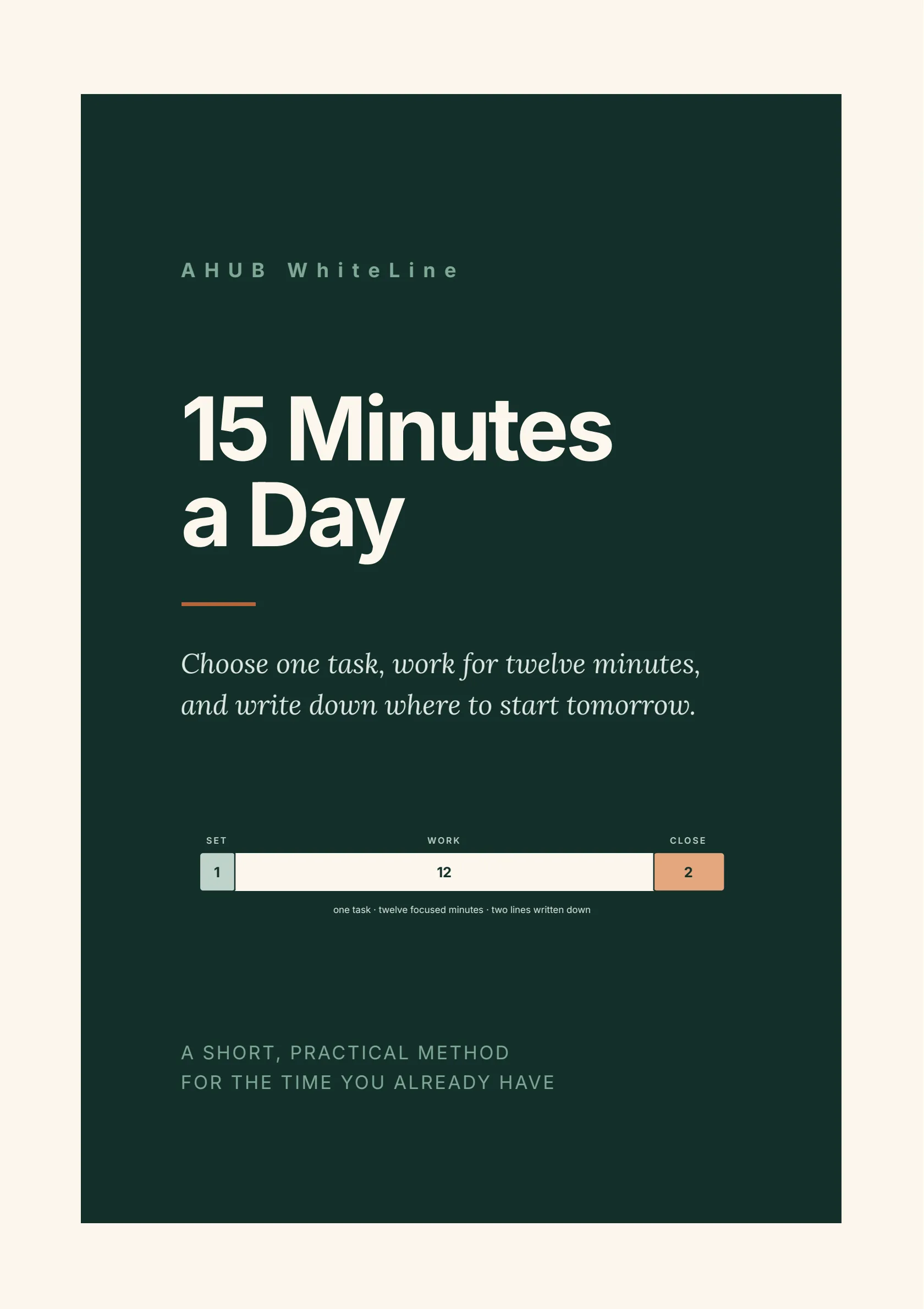
15 Minutes a Day
Choose one task, work for twelve minutes, and write down where to start tomorrow.
- PDF ebook
- Six printable worksheets
- Seven-day practice week
Regular price ₹699₹99Launch Price
Purchasing is not open yet.
- Your download link is emailed to you after payment.
- Questions? Customer Support · Refund Policy
The problem
Why the small gaps in your day go unused
You open the course you paid for. It says you finished lesson 4 — and you can't remember what lesson 4 was about. You'd have to rewatch it to find out. That's twenty-five minutes, and you have twenty, so you close the tab and decide you'll do it properly at the weekend.
The thing stopping you isn't a shortage of hours. It's the cost of getting back into the work: finding the file, remembering the plan, working out what you were in the middle of and why. If that reconstruction takes fifteen minutes, every small gap in your day becomes useless — not because the gap is too short, but because your project is too expensive to open.
The method
One small session, in three steps
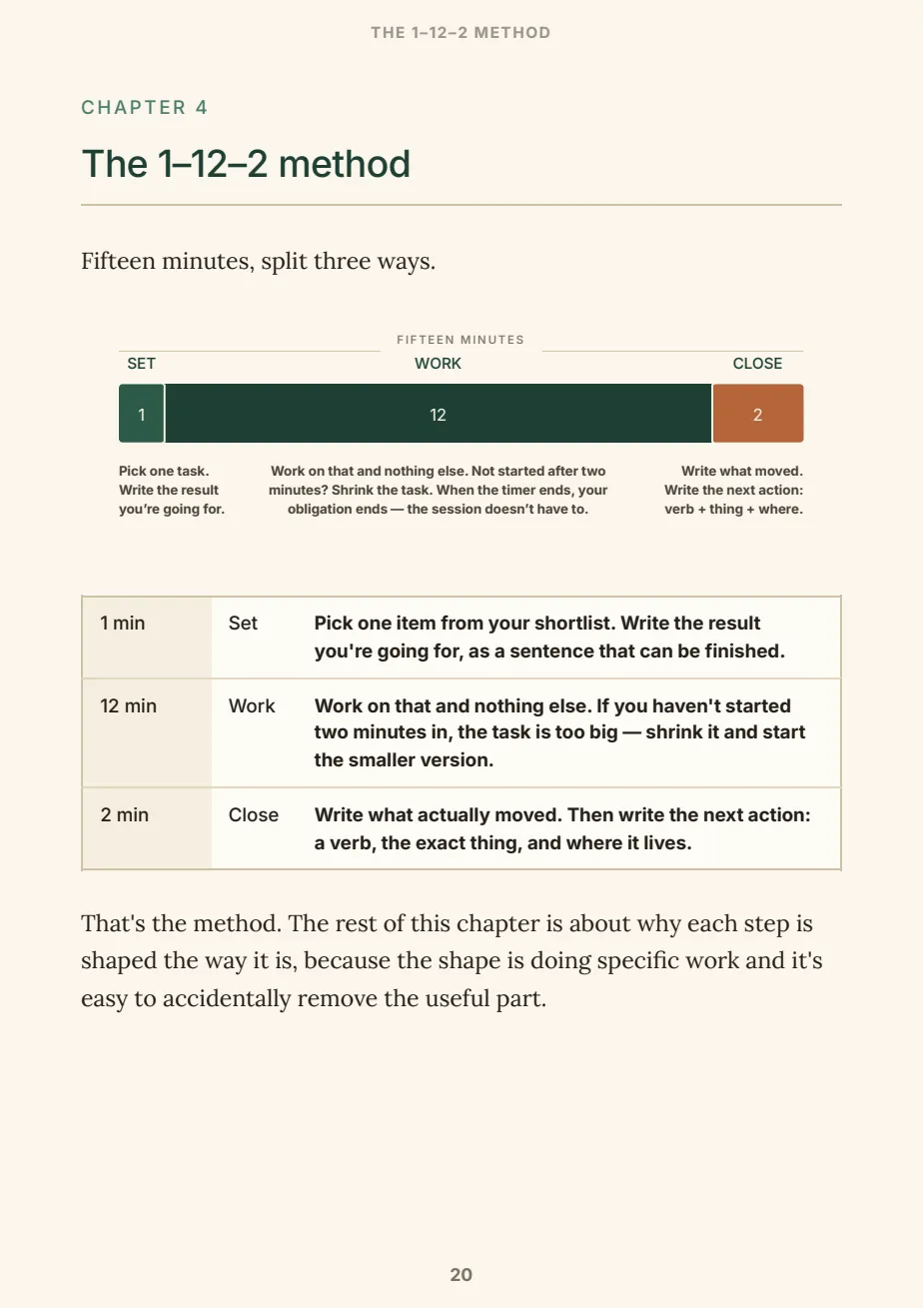
The guide teaches one method: the 1–12–2 session. It is short enough to do on a tired evening, and it ends by making tomorrow easy to start.
- 1minSetChoose one task and write down what you are aiming for.
- 12minWorkWork on that task and nothing else.
- 2minCloseWrite what moved, then write your next action precisely enough that a tired version of you could follow it tomorrow.
Those two written lines are what make the next session cost under a minute to start instead of fifteen.
A session with a defined start and a written end
One minute to choose, twelve to work, two to record. Short enough to actually do on a tired evening.
Sessions that start in under a minute
The next-action format means tomorrow-you follows an instruction instead of reconstructing where you were.
A realistic way to choose what matters
A ten-minute weekly routine that reduces everything in your head to a shortlist of three.

What is included
Everything you receive
- The guide, screen edition (A5)Sized for reading on a phone, tablet or laptop.
- The guide, print edition (A4)For reading on a computer, or printing the whole guide.
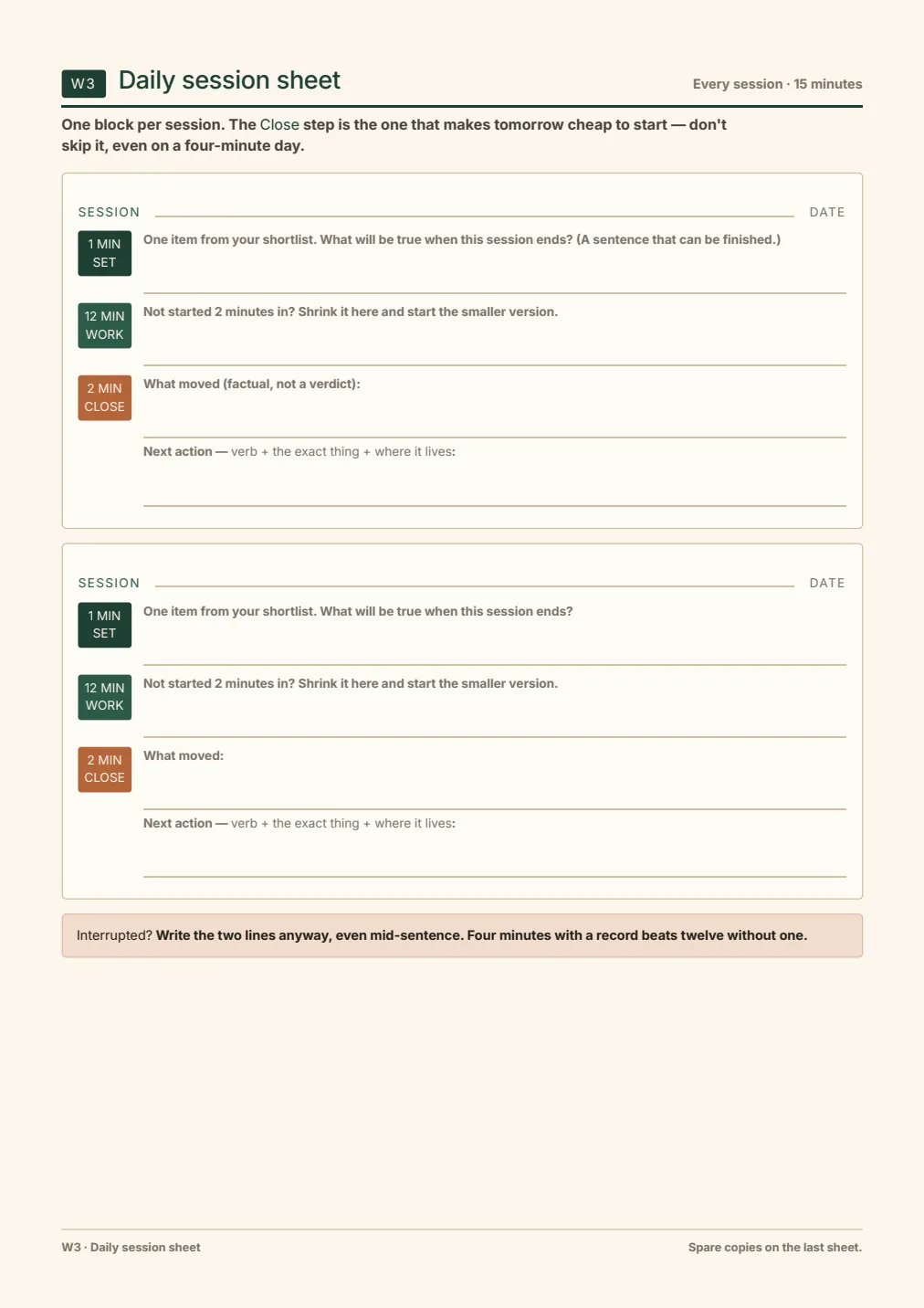
- Worksheet pack (A4)Six worksheets: brain dump, shortlist, daily session sheet, seven-day tracker, weekly reflection and distraction checklist, plus spare session sheets.
- Seven-day practice weekA day-by-day plan in the guide, with a tracker in the worksheet pack.
Contents
- 1. Fifteen minutes is not the point
- 2. Why waiting for the right time doesn't work
- 3. Choosing what actually matters
- 4. The 1–12–2 method
- 5. Making a task small enough to start
- 6. Making it easy to start tomorrow
- 7. Bad days, distractions, and where this doesn't work
- 8. Your seven-day practice week
- 9. What to do after seven days
- The worksheet pack
- Sources and honest limits
Is it for you?
Who this guide is, and is not, for
It is for you if
- You have a project that's been stalled for months
- You have small pockets of time and can't seem to convert them into progress
- You're a student, working professional or freelancer
- You want a method you can learn in forty minutes and use the same day
It is not for you if
- You want a complete life-management system — read Getting Things Done instead
- You want the psychology of why you procrastinate — there are better books for that
- Your calendar is already full and optimised — this will be too basic
- You're looking for help with burnout, ADHD or depression — this isn't that, and it doesn't pretend to be
What it does not promise
- It won't transform your life in a week.
- It won't build you a permanent habit in seven days — habit research suggests that takes considerably longer, and varies enormously between people.
- The method isn't scientifically proven. The book is clear about which parts rest on research, which are defaults the author chose, and which are untested. Every source is listed on the final page.
Questions
Before you buy
What exactly do I get?
Three PDF files: the guide in a phone-friendly size, the same guide sized for paper, and a worksheet pack. Under 1 MB in total.
How long does it take to read?
About forty minutes for the whole guide. If you only have ten minutes, Chapter 4 is the complete method with a worked example.
Do I need a printer?
No. The worksheets are designed to be printed if you want them on paper, but the method works on any blank page. The daily sheet is four lines.
Can I read it on my phone?
Yes. That's what the A5 screen edition is for. The A4 edition is better on a computer or printed.
Ready to try the 1–12–2 method?
See purchase options